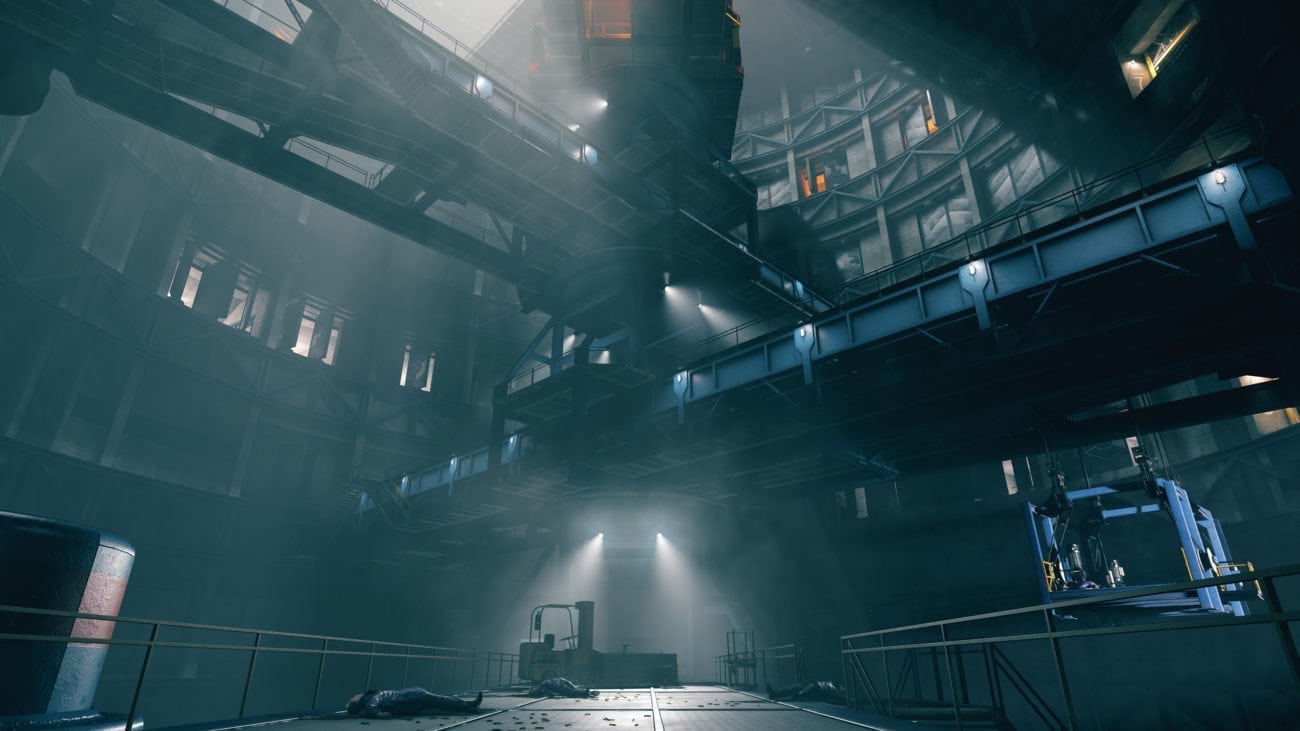
There are places in our world where fiction and dreams can come true.


17th March 2022
Guest Article: Control and the Pandemic Workplace
by Lindsey Stark

To celebrate the tenth anniversary of the site, we ran a competition with prizes kindly donated by Remedy. There were three categories that fans could enter for a chance to win a money-can't-buy Control camping mug; fan art, article, and cosplay. Our winning writer was Lindsey Stark whose incredible article about Control reflected on how 2020  might have changed how fans could see the game. Their article looked at productivity and surveillance both at the bureau and for remote workers. You can read her full article below... 

Control, surprisingly, is not billed as horror. Officially, it’s billed as an action-adventure game. It certainly has no shortage of action and adventure, but anyone who’s played it can tell you; this game is scary. From the mind-rending idea of having a resonance, a sound, burrow into your mind and carve you out of yourself to the truly harrowing notion of being killed by a fridge, Control has its fair share of horror. The most prevalent horror, though, is not something the developers could have anticipated. Control was released in August of 2019, and wouldn’t see its most impactful themes realized until March of 2020.

Control makes excellent thematic use of the concepts of liminality and surveillance. The FBC takes the idea of a liminal space and makes it quite literal; the Oldest House is in a permanent state of transition, its halls, offices, and bathrooms constantly shifting, creating chaos for the employees there. This serves as what was once a hyper-absurd critique of bureaucracy and at-any-cost capitalism. Posters sternly declare that overtime will not be paid for any hours lost due to house shifts, and documents scattered throughout the FBC are notably bickering about the budget allocated to different departments.

Posters that players can find in the FBC. (Source: Remedy Store)

I think that this reached a new level of relevance during the COVID-19 pandemic. Has capitalism always been this way? Absolutely. Any functional society would make all allowances for surviving a deadly infectious disease ripping through the entire planet, but the United States chose a different tactic, one of profit and loss. Their attitude is so closely aligned with the FBCs that it would be laughable if it weren’t so damaging. Like the Oldest House’s literal, physical foundations constantly shifting, the American worker’s foundation has been unmoored and built on sand for many decades, a fact that COVID-19 cast an ugly light on. The FBC’s overtime posters feel a little different than they did the first time I played it.

The other thing about Control that hits harder now than when I first played it is emptiness. Who among us in the U.S. doesn’t remember our first trip to a grocery store during the Great Toilet Paper Shortage of 2020? I’ll never forget wandering the aisles, seeing entire shelves cleared of canned goods, pasta, and cleaning supplies, meeting the eyes of people who were also there for the first time and shrugging helplessly at one another. Walking around an empty downtown law firm that was unceremoniously abandoned two years ago helps one to imagine what Jesse Faden feels walking through the halls of the FBC.

The Panopticon.

For remote workers, Control’s use of the Panopticon has an interesting parallel as well. The Panopticon takes its name from a concept developed by Jeremy Bentham and popularized by Michel Foucault, who used panopticism to comment on incarceration in general. The concept is that one guard can view many prisoners at the same time, but they will never know if they’re being surveilled or not. This is true of the Panopticon in Control as well; there are a limited number of humans to view the cameras, but Altered Items must all be watched at the same time. Remote workers learned how this felt when their employers started monitoring their activity at home, recording things like mouse activity, browser history, and keystrokes, all in the name of productivity.

Control
is a fantastic game in many respects. Its gameplay is a perfect complement to its storytelling, and its characters, graphics, and immersion are at the peak of quality that players have come to expect from Remedy Games over the years. But all great art is at the mercy of its audience. Control is scary, and it’s also a deeply, wryly funny game. The last two years have just made that humor a little darker.

12th January 2014
Guest Post: Stacy (Photograph Competition Winning Entry)

Over the festive season we held a competition for a photograph signed by the incredible, Fred Berman. To enter, fans had to suggest ways in which Remedy might pay homage to their previous titles in Quantum Break, like they had with Alan Wake. We're pleased to announced that after several days of reading and re-reading entries we finally have our winner; Stacy! You can check out her brilliant entry/story below:

What if Quantum Break is actually tied directly to Alan Wake and what the Darkness is doing to his world? Perhaps the Dark Place switching out Alan for Mr. Scratch created an open door for things to cross over to our world that never should have been able to. What if these series of events caused the experiment to go wrong on purpose; attempting to control time to bring itself back to when it was at it's strongest. With the worlds connected by this doorway, there would be a bleeding effect. The only way to stop the time anomalies, would be to figure a way to save Alan, and to do so, they would need to find Alice. This is something that might happen. Enjoy!

Jack sat on the floor behind an over turned table trying to catch his breath. Debris from the destroyed windows littered the floor everywhere. The air was filled with dust that glittered through the sunbeams shining through the now gaping hole that was once a wall.

How did things go so VERY wrong? The accident at the University this morning, now he was separated from Beth; he didn't know how much more his mind could handle. Shifting his weight, he took his cell phone out of his back pocket and unlocked the screen. “Just great, no service.” He sighed, closed his weary eyes and leaned his head back against the cool wood of the table.

I just need to stay calm and... his phone began ringing, cutting through his thoughts and startling him back to reality. “What the...hell...,” he held the phone up to see who the caller was, noticing that he still had no signal and the caller was showing as “Unknown”. Hesitantly, he answered the call:
“Hello? Who is this? Beth...?”
“Alan. Please help me,” a woman answered brokenly on the other line.
“Alan? I think you...”
“Stop talking,” answered back a gruff sounding man cutting him off. “You'll do exactly what I say if you want to see your wife again.”
“Who is this?”
“Go to the back lot. There's a hole on the fence to the left. Look inside the junker. I left a little something there to convince you we're on the same page here. After you ditch the cops, meet me in central park. There's a spot called Lover's Lane. Midnight. And don't do nothin' stupid, pal. We're watching you,” with that, the phone went dead, leaving Jack confused and angry.

Who is this Alan guy, and why did they think I'm him? If I don't check this out, they might hurt this mans wife... but I need to find Beth. Maybe this Alan person knows something...

Jack checked his watch, quarter to 6. He couldn't just let an innocent person get hurt. Perhaps he'll run into Beth on his way there. Getting off the floor, he brushed the dust from his pants and returned his useless phone to his pocket.

He took a few steps, and then it happened; his body tingled from head to toe and suddenly everything around him was quickly flying past; tables righted themselves, papers returned to their folders, windows were suddenly repaired. The room looked as if nothing had taken happened. The hole in the building was gone. Not even one piece of dust was out of place. Like a clap of thunder, all the sound returned accompanied with all the people making it. He looked at his watch. It was exactly five minutes before the anomaly destroyed the building and prevented him from reaching Beth.

Blinding pain raced though his head suddenly. Flashes of dark figures entered into his field of view, disappearing every time he turned towards them. Suddenly pieces of paper began raining down from nowhere, and someone was screaming his name.

Jack fell to the ground, gasping for air, panicking and clawing at this throat. He then felt hands touch his face gently and he opened his eyes.

“You had me worried Jack! You blacked out!” Beth was holding him in her lap, sitting behind the wooden table in the same spot, in the same building.

Jack looked at her puzzled, then felt the weight in his left hand. He brought his phone up and noticed it was on the same page he left it to when everything went to shit; Alan Wake's Departure on Amazon. He was showing it to Beth... that's right. He wanted her to read it, because of the Author disappearing and everything.

“I'm okay Beth. We need to get out of here,” he said putting his phone away. “You don't need to tell me twice. There is an emergency clinic a few blocks down. You need to see if you have a concussion.”

Helping Jack get to his feet, she noticed he had been sitting on a piece of paper. That in of itself wasn't the weird thing. The fact that it was font from a type writer, was what had gotten her attention. Beth picked the paper up and looked it over.
“Do you know what this is,” she asked Jack holding it up for him to read:


At that moment, Jack knew there was some dark force behind the experiment going wrong. The same strange evil thing that called him looking for that man named Alan. Something bigger than him, something bigger than Monarch was at play here and he needed to find out what it was, so he could stop it.

Beth looked at him with confusion and fear in her eyes. She was looking to him for answers and security. He could give her neither. “Come on, we need to get out of here.” With Beth's supportive shoulder, they made it out of the building, hoping to solve this impossible dark mystery.

30th April 2013
Guest Article (POTF): Zoltar Figure by PieRaptor

Today I'm going to introduce to you a lovely Poets of the Fall fan known on the Internet under her super secret ninja name, PieRaptor. Recently she wrote an article for our POTF event, regarding a figure she made inspired by Zoltar's appearance in Carnival of Rust.  Read the article below!

Hi everyone! First of all thank you so much to the hosts of this event for asking me to talk about this figurine I made based off the Carnival of Rust music video!


I’ll be talking about creating this figurine step by step, so if you would like to make one keep reading!

What I used:
Super Sculpey
Embossing Tool


And assorted acrylic paints! (Brown, black, white and blue!)

So…the structure of this figurine was easy. A ball for the head, and a square for the body! I added two tiny sausages for arms, as well, and ended up making the hat which was simply a cup shape with the rim facing up, and an oval in the center of the “cup”. I accidentally made the head of my figurine too big, so he occasionally falls over, oops! I recommend making a ball of tin foil the size you want the head to be and covering the head in clay, and making the base out of pure clay, so he won’t fall over constantly.

After attaching the head and base pieces I took my embossing tool and, with the largest end, I put two huge holes in his head. I wanted my figurine to look cartoony and I thought it would also be a neat way to add bags to the eyes! I made two tiny oval shapes and put them in the sockets for his eyes, then attached the arms and hat!

When I was done he looked like this: 


As you can see, there are small lining details in the hat that can be done easily with the smaller end of the embossing tool. He also looks dirty, but don’t worry about that, we’re painting over it!

Bake your figurine according to the instructions included in your clay! When your figurine has baked, let it cool completely. When it has cooled, if you want, you can paint a layer of gesso or primer on him. I did not do this but it is an option!

I painted his face pure white, and his body and hat brown. When the white paint dried I watered down some of the brown paint I used and put that in the “sockets” of his eyes to make him look like he had bags. After that I painted the black stripe on his left eye and then painted his eyes blue!


I hope that you enjoyed this article / tutorial! If you make a figurine off my tutorial PLEASE send me a link through my tumblr (http://pi3raptor.tumblr.com/) or my DeviantArt (http://pieraptor.deviantart.com/). I would genuinely love to see them! :D

26th January 2013
Guest Article: What is the Dark Place and its inhabitant the Dark Presence?
By April

Recently we concluded our writing competition; the author of the winning piece was April who looked into the representation and symbolism of the Dark Place, and possible repeating historical patterns. She's also incredibly talented at special effects make up; some of you may have seen her traumatising injury make-up work at the Remedy forums.

It's probably a question that a lot of Alan Wake fans have theorized on, and while we've been given subtle hints along the way, we're ultimately still left in the dark. Is the Dark Place another dimension, or does it merely reside in the deepest part of ones subconscious? Perhaps the answer is both.

I speculate that something does lurk beneath the depths of Cauldron Lake, but it has no true form because it is the Dark itself. It lingers beneath Bird Leg Cabin waiting for someone to bring it out from the abyss, and when some unfortunate person does approach, it is thus able to manifest itself in a number of ways once it gets a good look inside your mind. While it has the ability to take host of a body- a poor Barbara Jagger, "The Darkness wears her face"- it also has the capability to bring your worst fears to reality.

Take Alice Wake's fear of the dark as an example of how it can manifest. Jagger, now taken over by the Dark Presence, lures the Wake's to the cabin and not only kidnaps Alice, but possesses Alan to write a way for the Dark entity to be freed. It has Alan create a horror story because, in essence, it lives off of fear and feeds from his thoughts. Alice is crippled by the dark, Alan is struggling to write another novel, it manipulated them in order for one thing; to get what it wanted.

While it's able to reside in Jagger's body, it is still too weak to spread its evil passed Bright Falls, and therefore uses artists as a means to grow stronger. The Dark Presence knows that creativity is power; and therefore wills its way into the minds of those so eager to create.

The extended reach of the Dark Presence; its trap in the "real world".
But Alan was aware enough to know what was happening and escaped. The Dark Presence, now having read the minds of both the Wake's, is determined to get Alan back and, more powerful than before, spreads its evil through the dark, since that's how the story was created. And while Alice is more affected by the dark than Alan, he was afraid of the dark as a child. But the Dark Presence knows that his goals and his fears are the same and the most troublesome thoughts in his head.

It knew how to play him, especially in the DLCs, where it's apparent that the Dark Presence has a stronger hold on his mind while inside the Dark Place. Though the Wake's shared fear of the dark was able to physically absorb into the shadows and create Taken, only Alan's struggle to write was mentally haunting him.

Which leads us to the events of American Nightmare. Was that just a figment of Alan's mind while still trapped in the Dark Place, or had the Dark Presence seeped out into the real world and left its mark on a small Arizona town with other residents? Again, we don't know for sure, but I believe it's the former.

The most concerning of this event is that of Alan's doppleganger Mr. Scratch. His original purpose is vague- replace Alan while he's gone so his friends don't realize he's missing- and somewhere along the way, probably close to Alan's initial disappearance, Mr. Scratch abandoned his mission because he was just having too much fun. Or that was his plan from the start. This leads me to believe that, while Alan and Mr. Scratch are two completely different personalities, they in fact share the same body. The only time they are ever seen together is in the town of Night Springs (A town named after a show Alan worked on) and prior to that, the Dark Place.

I've also come to theorize that Mr. Scratch may just be another manifestation altogether. He is literally Alan's negative; a fear of himself. And fear plays a prominent role in the Dark Presence's charades. So, was Mr. Scratch really out there in the real world tormenting Alice and the fans, or was he trapped alongside Alan because he was just a mere figment brought on by the Dark Place? And if Alan had lost, would Mr. Scratch be freed and sent out in Alan's body to spread the Darkness? I believe so.

Perhaps these same internal struggles could've been said for Barbara Jagger.

17th December 2011
Guest Article: Writing Alan Wake
by Mikko Rautalahti


Jaden: I discovered the "Ask Remedy" thread at the Alan Wake forums and a specific answer caught my eye. I love the Alan Wake script and so it was interesting to see one of the writers for the game talk about how the Alan Wake story was created. I thought it was a pretty cool insight into the game so I asked Mikko if I could repost it here, and he agreed. The reply was in response to Helspont at the forums who asked if companies accepted video game scripts. The only changes I've made to the reply was the addition of the images.

Mikko: Now, I'm going to be blunt right off the bat: if you have a story and a script for a game and you're trying to get somebody to pick it up, it's very unlikely to happen -- so unlikely that, in fact, that the only reason I'm not calling it impossible is because I have an aversion to putting things in absolute terms like that. I'm sorry, but honestly, that's just how it is. There may be people out there thinking that they want to make a game but they just don't have a good story for it, but they are very few and far in between. You might find somebody who has a story idea and they need somebody to actually flesh it out, but that's the best you can realistically hope for; it's not like the movie business, where scripts are in great demand, and they get bought all the time. (Far more of them get bought than filmed, but the demand is constant.) You kind of need to be in from the ground floor when people are talking about what kind of a game they want to make, and that's not an easy spot to get into if you're not already working in the industry.

For us (and other companies may and do work differently), we start with a concept, and that involves story elements, absolutely, but we also need to know that it'll make a good game. So for example, with Alan Wake, you can bet that at the time the idea of a writer fighting darkness with light was brought up, the kind of gameplay that might involve was also on the table already. There are certain things that we know from the get-go -- for example, we make third person games, and that immediately has an impact on how we work.

When we're working on the story stuff, other people are already working on other things, so there's constant interaction -- if they come up with game mechanics that don't seem to fit the story, we bring that up, and if the story stuff doesn't seem produce useful or fun game mechanics, they bring that up. There are also technological aspects to this -- for example, if it had turned out for whatever reason that we couldn't get the lighting effects we wanted, Alan Wake might not have happened at all, because light is so integral to the core concept!

So it really is a cooperative endeavor. We start by figuring things out in very broad strokes, and the details can change a great deal at this stage. The thing is, you don't really know if an idea works until you try it out to at least some extent and figure out what it really means in practice, so you often have to change your mind. For example, at one point Alice Wake had died in a car accident before the events in the game, and that was changed for a number of reasons, but especially because it was felt that if she was dead, it was very hard to find opportunities for her to become an actual character in the story, somebody Wake could love. We wanted to establish her as a presence in his life before things started happening, so we changed that. Things like that happen all the time. At the same time, the story is also influenced by the developing game design. They are two aspects of the whole that need to support each other.

I write, sure, but I would say that overall, I only spend maybe 20-25% of my time actually writing. The rest of the time is spent in meetings -- which sounds kind of horrible when you look at it like that. But that's the job. The writing is obviously important, but it's essentially useless if I don't know what others are doing, and if they don't know what I'm doing. I don't work in a vacuum; a lot of my job is just talking to people. On a good day, I can spend the whole day in meetings and feel like I got a lot done -- not because my own work progressed, necessarily, but because I figured out how to get that work done, or helped others do their work. (I also have a lot to do with things like the characters' voices and the audio side of things in general, and localization often needs some support from me, etc. -- I'm pretty busy. So at least at Remedy, the writer tends to be extremely involved with the production.)


So, in answer to your question, I do get involved in the gameplay, often very much so -- the scenes that involve NPC interaction tend to be especially important for storytelling purposes, so those take up a lot of my time. But it's a two-way street; often I have something written that doesn't make for good gameplay, and I have to change it. The more back and forth like that there is, the better the end result generally is. Obviously, there are things that we can't change -- for example, if you look at Alan Wake, we have the New York flashback sequences, and if our gameplay designers had come to me and said that we need to have some combat in there, I would've had to say no, that's not going to happen. On the other hand, if I go to the gameplay designers and say that hey, I just wrote this sequence where Wake goes blind and the player mustn't see anything either, they're going to tell me to write something they can actually make work. (Note that this doesn't mean that a brand new feature couldn't be created because of story demands, but that's not something you just drop in somebody's lap.)

Our level designers and environment artists are super cool people, and they often find ways of telling the story better, or new ways of accentuating a story point, which is awesome, and that wouldn't happen if we didn't spend time talking about this. That's the difference between trying to tell a story as well as you can and simply throwing it at the player between action sequences, cut'n'paste style. And I am not exaggerating at all when I say that they're the ones who make the stories come alive -- sure, I think we write good stuff, but they're the ones who implement it. Invariably, the closer we work together, the better the end result is.

The actual script is definitely written with gameplay in mind -- if it wasn't, it wouldn't be very useful, and it would end up being changed by necessity. But again, it's a two-way street: for example, the stage fight in Alan Wake was something we came up during the writing process, and it ended up being one of the coolest moments of the game for a lot of people. (It's also a great example of how important the gameplay design work is -- in the script, that entire scene is fairly short, consisting mostly of Wake and Barry's banter. When you actually play it and get the light show, the music, the big Taken waves, it feels undeniably epic, and that wasn't something we could just write. There was a lot of creativity there that had absolutely nothing to do with writing, and I think it effectively illustrates the difference between having an idea and actually making it work. Writing absolutely didn't do the heavy lifting in that scene!) On the other hand, the nightmare sequence in the very beginning of Alan Wake was very much dictated by gameplay requirements, because we had the whole tutorial thing to take care of. We must've rewritten the details of that scene a dozen times as the gameplay changed.


It's also worth noting that what I've outlined above tends to be true for us, but it doesn't necessarily apply to every game studio out there. We take story very seriously, it's one of the things that Remedy is known for, but some companies take a different approach -- it's not at all unheard of for a company to simply hire a freelance writer who produces a script, and doesn't actually get very involved in the production itself, if at all. It generally doesn't lead to a very story-driven experience, but it can still result in a kick-ass game.

Let me tell you another thing that people typically don't realize: storytelling is expensive, and by that I mean it takes a lot of time from a lot of people. For example, the diner scene in the beginning of Alan Wake seems pretty simple -- you walk through the area, people talk to you, you can play the jukebox and people react to it, etc. But it's actually a very complex scene, because of the way the characters' dialogue is triggered. All of it is custom stuff, and that takes a lot of time to get right, but the end result feels very immersive and atmospheric. It's difficult, and there's no way it could have been accomplished if there hadn't been such a close relationship between gameplay design and writing.


---- -------- ----


This article was taken with permission from the Official Alan Wake forums, in the "Ask Remedy" thread. A big thank you to Mikko for letting me to copy it here, it was really interesting to hear about the creation of the Alan Wake story :)

-- CONSOLE & PC GAMES --

The CONTROL Series

The Crossfire Series

The Quantum Break Series

The Alan Wake Series

The Max Payne Series

Additional

-- MOBILE GAMES --

-- LIVE ACTION SERIES --

Icons by the incredible, Evil-Owl-Loki.

Beyond the shadow you settle for, there is a miracle illuminated.